STARTMAKINGSENSE

Inter-Pillar Interfaces

The seams where capability domains intersect. These interfaces define how identity context, policy decisions, telemetry, and governance signals move between IAAI pillars.

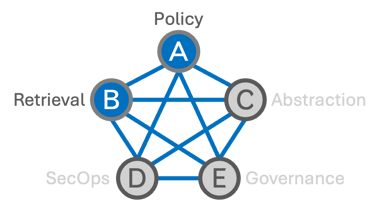
Policy - Retrieval

A to B interface diagram

A to B: Entitlement definitions and runtime policy decisions consumed by retrieval enforcement points.

B to A: Retrieval coverage gaps, prompt-injection-induced bypasses, and ungoverned access paths identified during Pillar B operations surfaced back to Pillar A for policy correction and control-plane hardening.

Commons DraftEditorial research

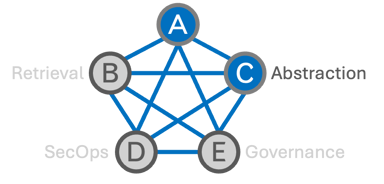
Policy - Abstraction

A to C interface diagram

A to C: Policy definitions for read, transform, and reveal rules plus clearance tiers consumed by abstraction output governance.

C to A: Abstraction tier compliance gaps, seal-break events, and overexposure patterns surfaced back to Pillar A for policy refinement and tier model evolution.

Commons DraftEditorial research
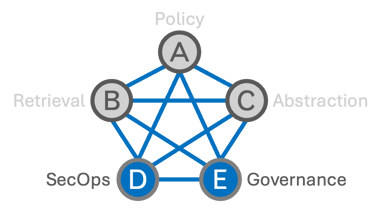
Policy - Operations

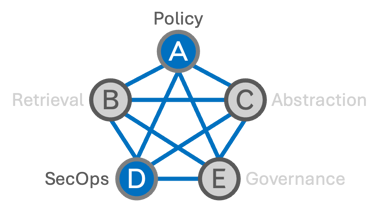
A to D interface diagram

A to D: Policy version metadata, entitlement baselines, and credential or access change events consumed by Pillar D for anomaly detection and SOC workflows.

D to A: DLP violations, abuse patterns, red-team findings, and DSPM discoveries used by Pillar A to adjust entitlements, segmentation, and technical controls—the core technical feedback loop from operations to policy.

Commons DraftEditorial research

Policy - Governance

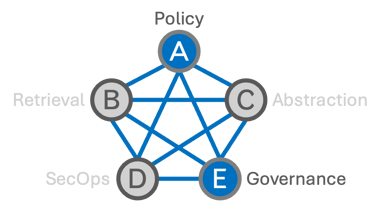
A to E interface diagram

A to E: Implementation status, coverage metrics, and certification results for identity and authorization policies consumed by E-AIG for AI risk assessment and reporting.

E to A: Governance decisions, control objectives, and prohibited use cases translated into specific policy-engine rules, IGA roles, and technical constraints in Pillar A.

Commons DraftEditorial research

Retrieval - Operations

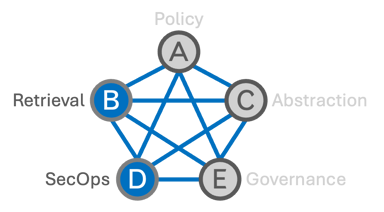
B to D interface diagram

B to D: Retrieval audit logs—who retrieved what, from which corpus, using which policy version—consumed by SIEM, DLP, and anomaly detection.

D to B: Retrieval-scope anomalies, prompt-injection-derived bypasses, and data exfiltration patterns used to tune retrieval filters, corpus partitioning, and hardening in Pillar B, in parallel with D’s technical feedback to Pillar A.

Commons DraftEditorial research

Retrieval - Governance

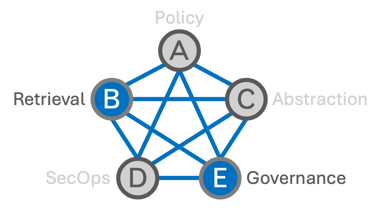
B to E interface diagram

B to E: Retrieval coverage reports, ungoverned AI access paths, and corpus risk profiles provided to Enterprise AI Governance for inclusion in the AI risk register and use case decisions.

E to B: Governance directives on which corpora may be used for which AI use cases, jurisdictions, and tenants, typically expressed via Pillar A policy or GRC workflows that then drive changes in Pillar B configuration.

Commons DraftEditorial research

Abstraction - Operations

C to D interface diagram

C to D: Output classification, clearance tiers, and redaction actions for each AI response provided to DLP, SIEM, and disclosure logs.

D to C: Output DLP violations, disclosure anomalies, and abuse patterns used to refine abstraction schemas, redaction rules, and seal-break handling in Pillar C, alongside D’s technical feedback to Pillar A.

Commons DraftEditorial research

Abstraction - Governance

C to E interface diagram

C to E: Abstraction tier compliance, seal-break events, and disclosure patterns reported to E-AIG for AI risk reporting and policy review.

E to C: Governance decisions on acceptable abstraction tiers, redaction defaults, and disclosure constraints that shape Pillar C schemas, filters, and escalation rules, usually implemented via Pillar A policies and governance-aligned design guidelines.

Commons DraftEditorial research

Operations - Governance

D to E interface diagram

D to E: AI security incident summaries, DLP trends, red-team results, and operational risk metrics delivered to Enterprise AI Governance for AI risk register updates and board-level reporting.

E to D: Governance-defined AI risk tiers, escalation thresholds, and reporting expectations that shape alert severity, playbooks, and SOC workflows in Pillar D.

Commons DraftEditorial research